# CI/CD @ TrackCode
### Using Jenkins, Helm & Kubernetes
---
### Content
- About me
- Definition of CI/CD
- Existing Stack
- Implementation
- Pros & Cons
- Whats next?
---
### About me

Julian Tölle
Developer @ narando & TrackCode
Backend Development & DevOps
--
### About us

- ~ 5 Employees
- Last-mile scanning solution for logistics
- Nodejs + React
---
### Definition of CI/CD
#### Continuous Integration
> Continuous Integration (CI) is a development practice that requires
> developers to integrate code into a shared repository several times a day.
>
> Each check-in is then verified by an automated build, allowing teams to
> detect problems early.
From [ThoughWorks](thoughtworks.com/continuous-integration)
--
### Definition of CI/CD
#### Continuous Delivery
> Continuous Delivery (CD) is a software development discipline where you build
> software in such a way that the software can be released to production at any
> time.
From [Martin Fowler](https://martinfowler.com/bliki/ContinuousDelivery.html)
--
### Definition of CI/CD
#### Summary
- Merge often
- Test everything
- Deploy quickly
---
### Existing Stack
- Bitbucket Server
- Jenkins
- Dedicated machines for each service
--
### Existing Stack
#### Jenkins
- Seperate jobs per service instance and environment
- Polling for SCM changes
- Freestyle jobs executing shell:
```bash
rsync -avz . jenkins@SERVICE-MACHINE:/var/www/
ssh jenkins@SERVICE-MACHINE "./deploy.sh production"
```
--
### Existing Stacks
#### Pain Points
- Configuration only in Jenkins
- No hermetic builds
- Deploying means capacity reduction
- Only application, no infrastructure
---
### Implementation
#### Premise
| Deployment Target |
Kubernetes |
| Build Tool |
Jenkins |
--
### Implementation
#### Workflow
1. Make changes and commit
1. Create PR from feature branch to `master`
1. Automatic tests and linting provide inline feedback
1. Code Review from peers
1. Act upon test and review feedback
1. Merge
1. Deployment is triggered
---
### Implementation / Build
- Triggered by Webhook
- On every push/pr
- Steps defined in `Jenkinsfile`
- Build defined in `Dockerfile`
--
### Implementation / Build
#### Jenkinsfile Build Steps

--
### Implementation / Build
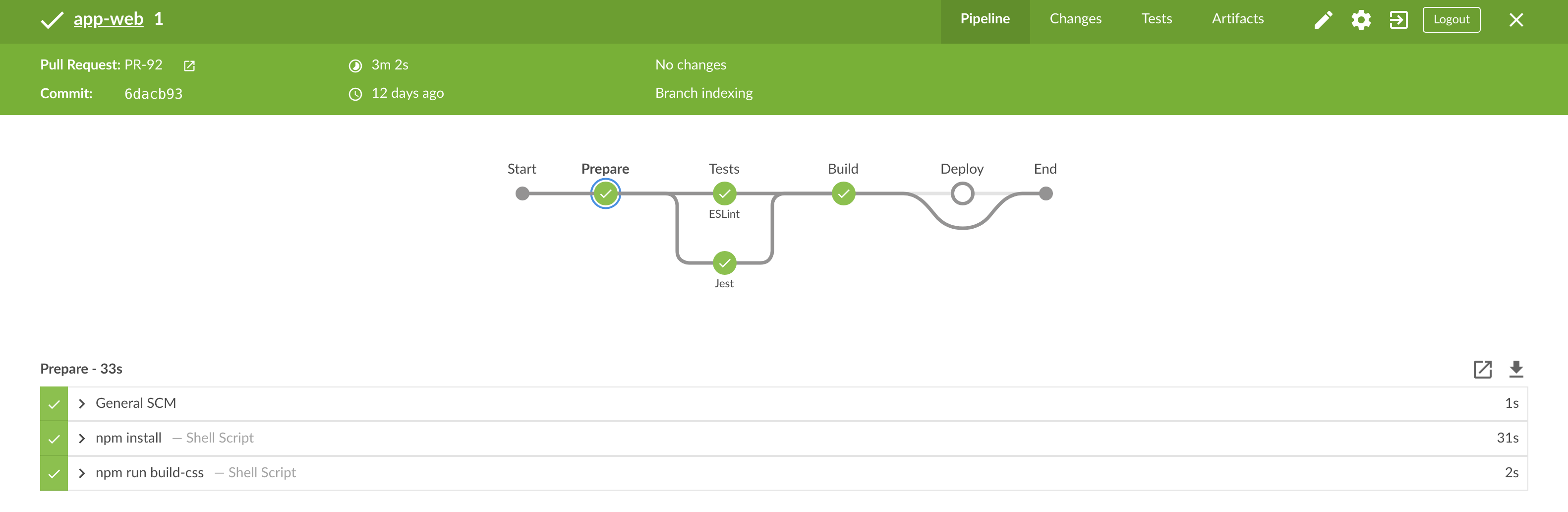
#### Jenkins Blue Ocean UI
---
### Implementation / Deployment
- Defined in same `Jenkinsfile`
- Executed when `branch IN (master, dev)`
--
### Implementation / Deployment
#### Helm
- Incubating CNCF Project
- "Package Manager for Clusters"
- CLI Tool (`helm`) and in-cluster Operator (`tiller`)
- Only used for templating
- Alternatives: ksonnet, kubetpl, ...
--
### Implementation / Deployment
#### Helm Workflow
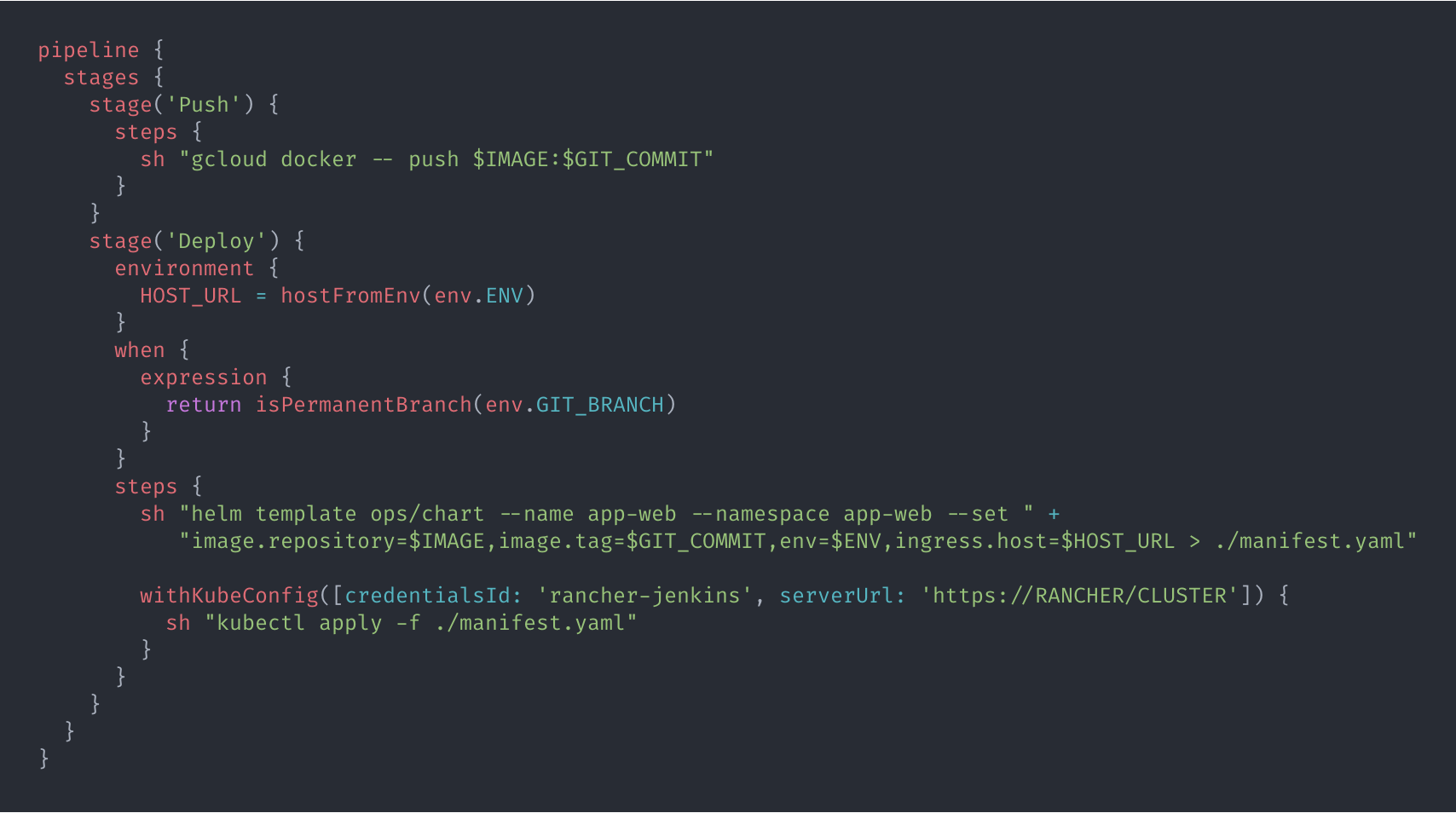
- Render Helm Chart to Kubernetes Manifest
- Apply Manifest against cluster
--
### Implementation / Deployment
#### Folder Structure
```
app-web
└── ops
├── chart
│ ├── Chart.yaml
│ ├── templates
│ │ ├── configmap.yaml
│ │ ├── deployment.yaml
│ │ ├── _helpers.tpl
│ │ ├── ingress.yaml
│ │ └── service.yaml
│ └── values.yaml
└── nginx
└── default.conf
```
--
### Implementation / Deployment
#### Jenkinsfile Deploy Steps
---
## Pros & Cons
### Pros
- Explicit, reviewed, tracked configuration
- Infrastructure also deployed
- Clean builds
- Every commit/pr is build
--
## Pros & Cons
### Cons
- Dependency on local tools
- `kubectl`, `helm`, `docker`, `npm`, `node`
- Leftover build artifacts
- Groovy is unnecessarily verbose
- Missing clean up of orphaned k8s resources
---
### Whats next?
- Container native build tools
- e.g. Drone.io, Jenkins X, Concourse
- explicit tool dependencies
- built-in docker garbage collection
- Helm v3
- deprecation of `tiller` in favor of `CRDs`
- still allowing clean up of orphaned resources